


Growing Up Maltese Without Being Recognised as Maltese

They speak Maltese, celebrate village festas and cheer for Malta's national teams. Yet for some children growing up on the island, there is one thing they still do not have: a nationality.
Michael was born in Malta nineteen years ago. He attended public and church schools, served as an abbati, played football with a local club since the age of four and says he feels Maltese "in every meaningful way". Yet as he approached adulthood, he realised that legally, his place in the country remained uncertain.
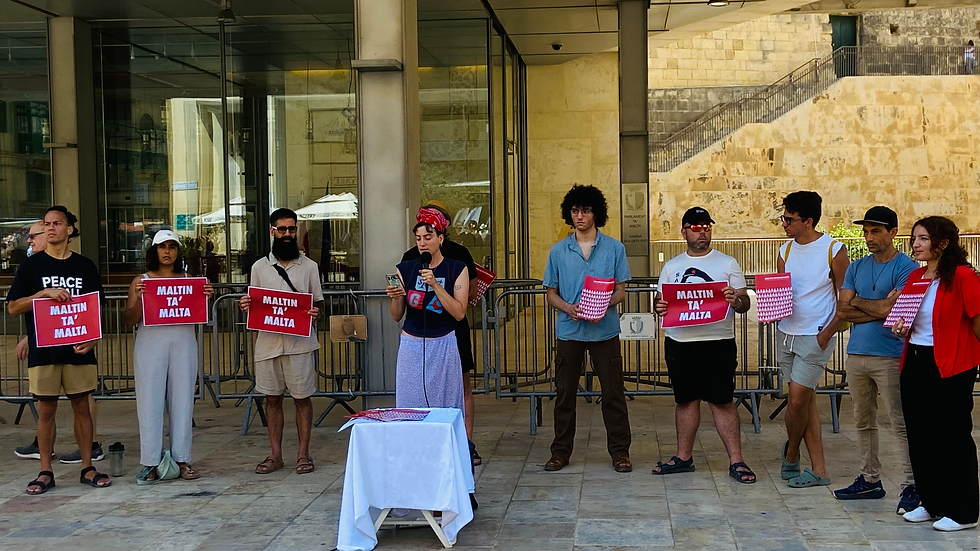
His story is one among what campaigners believe could be hundreds of cases of children growing up in Malta without a nationality. A new white paper, Ending Child Statelessness in Malta, launched by Moviment Graffitti outside Parliament this week, argues that child statelessness remains an overlooked reality sustained by legal gaps, the absence of identification procedures and a lack of institutional recognition.

Statelessness in Malta
Michael's experience is not unique.
In recent years, migrants and their families have repeatedly taken to the streets, insisting that Malta is the only home many of their children have ever known. Yet for some, belonging socially does not translate into belonging legally.
According to the white paper, statelessness in Malta is not explicitly created by law but emerges through administrative and legal shortcomings. Malta does not grant citizenship automatically to children born on its territory to foreign parents. While such children may theoretically acquire their parents' nationality, this is often impossible in practice because of conflict, persecution, discriminatory nationality laws or a lack of documentation.
Reliable data on statelessness is also largely absent. Malta's 2021 census recorded 171 stateless persons, nearly half of whom were children, but civil society organisations believe the figure is likely to be significantly higher. Without a system for identifying statelessness, it remains impossible to know how many children are currently growing up in Malta without a nationality.
What is statelessness?
Statelessness is often confused with irregular migration, but the two are not the same.
An undocumented person may still possess a nationality but lack the legal authorisation to reside in a country. A stateless person, by contrast, is not recognised as a national by any state under the operation of its laws.
The report identifies several circumstances that place children at risk of statelessness in Malta. These include children born to rejected asylum seekers or undocumented parents, unaccompanied minors without access to nationality elsewhere, children born to single mothers from countries where citizenship can only be transmitted through fathers, and children born during migration journeys without proper registration.
Communities such as Palestinians, Kurds and Rohingya are also considered particularly vulnerable.
For many children affected, Malta is the only country they have ever known. They attend Maltese schools, speak Maltese fluently and participate in community life, yet remain legally disconnected from the society in which they have grown up.
What does the law say?
Malta is party to several international conventions aimed at preventing and reducing statelessness, including the Convention on the Rights of the Child and the 1954 Convention relating to the Status of Stateless Persons. International standards affirm that every child has the right to a nationality and oblige states to prevent statelessness wherever possible.
However, the white paper argues that Malta's domestic framework does not adequately reflect these commitments.
Citizenship in Malta is governed by the Maltese Citizenship Act, which does not automatically grant citizenship to children born stateless on Maltese territory. While the law allows a person born stateless in Malta to apply for citizenship upon reaching adulthood, campaigners note that this provision has rarely, if ever, been meaningfully implemented.
Naturalisation also remains largely dependent on ministerial discretion. Although applicants may meet residence and language requirements, the granting of citizenship ultimately rests with the responsible minister, and decisions cannot be appealed.
Campaigners argue that these legal gaps place Malta at odds with international standards designed to protect children's right to a nationality.
What is missing?
Perhaps the most significant issue highlighted in the report is the absence of mechanisms to identify stateless persons in the first place.
Malta currently has no formal statelessness determination procedure, no specialised authority tasked with recognising statelessness and no protection status specifically designed for stateless individuals. As a result, children who may in practice be stateless often remain invisible within administrative systems.
The report also highlights a lack of institutional capacity. There is no systematic training on statelessness for public officials, legal practitioners or frontline service providers, increasing the risk that stateless individuals remain unidentified and trapped in prolonged legal limbo.
Without reliable statistics, campaigners say, the phenomenon remains largely hidden from public debate and policymaking.
What impact does statelessness have?
For many children, the consequences of statelessness only become apparent as they grow older.
Opening a bank account, applying for further studies, participating in exchange programmes, seeking employment or travelling abroad can reveal barriers that their peers rarely have to consider.
The report recounts the story of Alex ( not real name), an eighteen-year-old who was born in Sudan to Ethiopian parents and has spent more than fifteen years in Malta. He speaks Maltese fluently, attended local schools and sees himself as part of Maltese society. In the report , he says:
I want to repay Malta for what it has done for me," he says in the report, "but because of my status I cannot give it my all.
Despite his passion for athletics and basketball, uncertainty surrounding his legal status has prevented him from representing Malta in sport.
Statelessness can also affect access to healthcare, social protection and stable residence rights. Families often face restrictions in employment, banking and other essential services, creating long-term insecurity that affects children's wellbeing and development.
Beyond these practical challenges lies a less visible burden.
Growing up without legal recognition in the only country one considers home can have profound psychological consequences. The report speaks of anxiety, chronic uncertainty and a diminished sense of belonging among children who participate fully in Maltese society yet continue to be treated as outsiders under the law.
A case study: Michael's turning point
For Michael, questions about status became impossible to ignore when he turned sixteen.
Until then, he says, he rarely thought about his legal situation, despite periodically renewing documents in Ħal Far. Things changed after completing his O-level examinations.
I then started to think about my status and the implications it could have on my life as I tried to open a bank account, apply for courses and eventually look for a job, he explains.
Michael held a Specific Residence Authorisation (SRA), a residence document that is no longer issued by the authorities. The status, inherited from his parents, generated what he describes as constant stress and uncertainty about his place in Maltese society.
"Whenever I go out and security asks me for an ID card, I get a bad feeling because I never know how I am going to be treated," he says.
With the support of his family, community organisations and NGOs, Michael eventually secured Maltese citizenship through an application to Aġenzija Komunità Malta. Campaigners argue that what makes Michael's story exceptional is not the experience itself, but the fact that his legal limbo was ultimately resolved.
For many others, they say, uncertainty persists.
Recommendations
The white paper calls for a series of reforms intended to prevent and reduce child statelessness in Malta.
Among the proposals is the creation of a dedicated statelessness unit within the International Protection Agency (IPA), tasked with identifying stateless persons, gathering reliable data and coordinating policy responses.
Campaigners are also calling for the introduction of a formal statelessness determination procedure, allowing individuals to have their status recognised through an accessible process with procedural safeguards and appeal mechanisms.
Other recommendations include granting protection status to recognised stateless persons, ensuring immediate birth registration for every child born in Malta and introducing safeguards so that children who would otherwise remain stateless can acquire nationality as early as possible.
Below you can download the full text of the report.


Comments